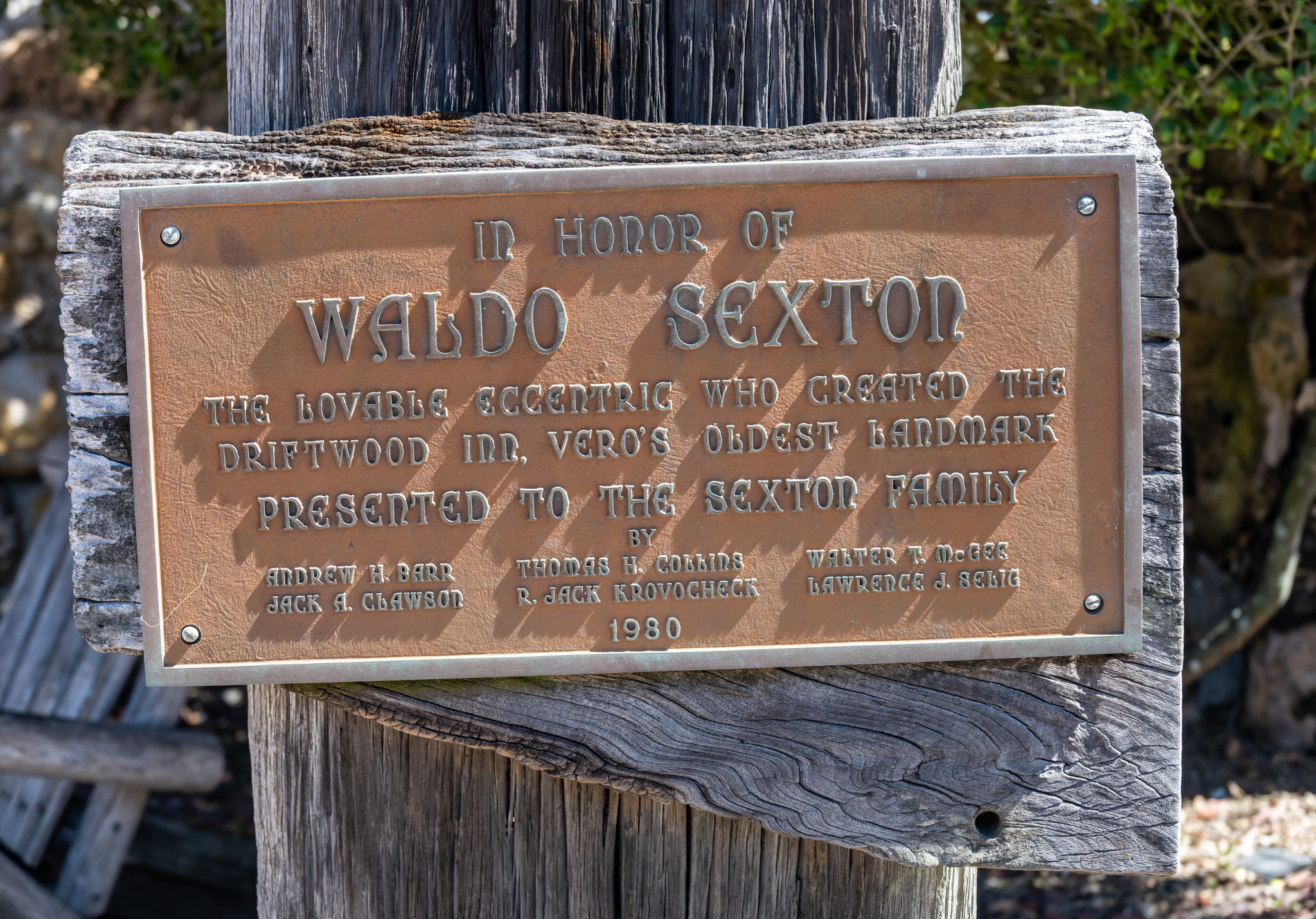
Do you remember me briefly mentioning Waldo Sexton's name in my post about Mckee Gardens?
Well if you don't recall, you can visit the post here.
Anyway, we encounter Waldo once again, but this time in a totally different location.
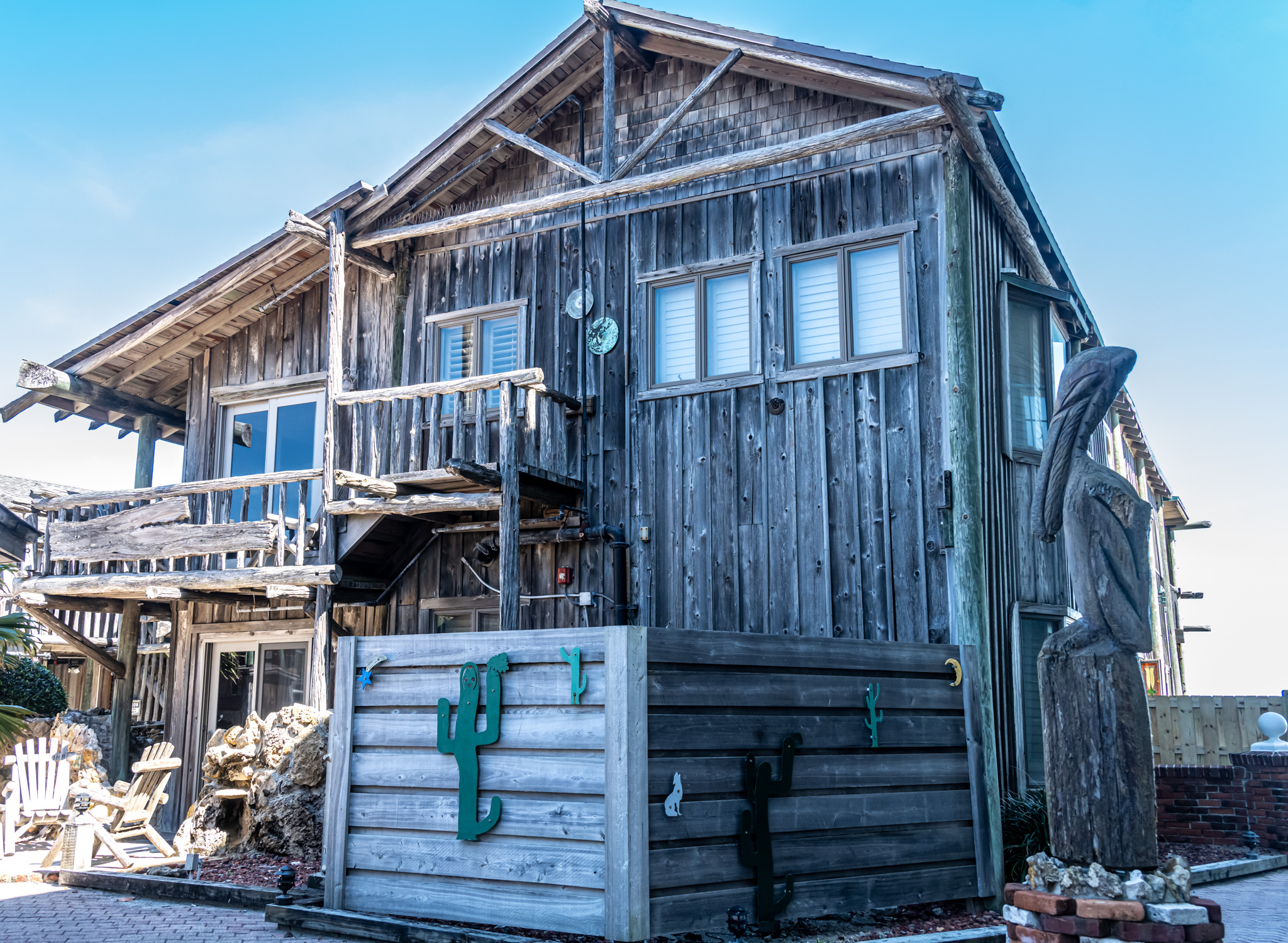
The location is the Driftwoon Inn Resort.
The name Driftwood and then Inn followed by the word Resort should give you a clue of what this location is all about. But at the same time, if you have ever been to Vero Beach you will wonder how this resort has #1 survived, #2 been missed so many times by me.
Ok I know you are definitely not wondering how I missed it, because after all you did not know I had missed it until I mentioned it here. But I did miss it within the times I have walked up and down this area.
And I have walked up and down this area SEVERAL times.
Look they even have a lane named after me!

I know, I know, you are saying: "Camellia that street name is spelled differently than your name."
But.....let me tell you a secret.....origianlly my birth certificate name has one L but somewhere along the line (those teenage rebelious years an L was added).
I digressed as my buddy Gethin would say, so let's get back to Waldo and the Driftwod Inn.
"An important personality in the vitality and growth of Vero Beach was Waldo Sexton.
Waldo was born in Shelbyville, IN. He graduated from Purdue University’s School of
Agriculture in 1911 and obtained a position as a salesman of tilling machines. During a 1914
sales trip to Florida, he decided to stay and work for Indian River Farms Company. By 1917
he was an independent citrus farmer, setting out 10,000 orange trees his first year. The
following year he married Elsebeth Martens, the couple had four children. Waldo became a
civic leader and was instrumental in furthering the citrus, cattle and tourism industries in
Indian River County.
In 1924 Waldo established the Vero Beach Dairy, the first dairy in Indian River County. He
was a pioneer in crossing the Guinea bull with Brahman cows, attempting to produce an
animal that required little in feed and that would be able to withstand Florida’s heat and
insects. During the depression years he was one of the members of the Florida Production
Credit Association. This organization made short-term loans to farmers to enable them to
plant their crops.
He
became one of Indian River County’s biggest developers and an enthusiastic supporter of
Vero Beach. Waldo established the Vero Beach Realty Company in 1914. In 1923 Waldo
was one of the organizers of the Vero Beach Real Estate Board and served as its president for
a number of years. He was a partner in McKee Sexton Land Company and the Royal Park
Company. Waldo selected the vistas for the first nine holes of the Royal Park Golf Course.
He also served as president of the Vero National Farm Loan Association, a local group that
processed loans for the Langwick Land Company Corporation, owners of a Vero Beach
subdivision. He was a partner with Arthur McKee in “McKee’s Jungle Garden” and was
reportedly the “idea man” for the early 1930s tourist attraction. In the late 1930s he opened
the Driftwood Inn for guests and in 1947 added a restaurant, now known as Waldo’s. The
Driftwood Inn and restaurant were the keystones which transformed the small oceanside
community of Vero Beach into a tourist mecca. By 1991 the Driftwood Resort was
generating well over $2 million annually for the local economy."

He has
variously been called “one of the most colorful persons that Florida has ever known”, an
”imaginative entrepreneur”, an “outrageous, old-time eccentric”, and an “irresponsible
screw-ball.” Not surprisingly, anecdotal stories of spirits and ghosts inhabiting the
Driftwood Resort are common local lore. Waldo died in 1967 at the age of 82.


The Driftwood Inn was originally a private beachhouse called the “Breezeway” by the
Sextons because of the opening in the central portion of the first floor. Construction of the
house began in 1935 and was completed in 1937. Two rooms originally flanked the first
floor. A kitchen was located on the second floor over the breezeway. A balcony extended
across the second floor. Brick chimneys also flanked the breezeway. According to family
members, a coiled pipe “solar unit” was contained within the chimneys to provide heated
water.
The original beach house was expanded in 1937 by the additions of a wing on the north; the
south wing was added in 1939. The original portion of the building is now the central
section.


The building is distinguished by board and batten exterior walls, wood-shingled gable ends
with decorative truss work and rustic balcony railings. The courtyard is marked by two stone
walls, into which are embedded two rusty, ancient cannons. Ceramic tiles decorate the
courtyard floor. A breezeway at the east end of the courtyard is flanked by stairs leading to
the second floor. The hallway at the north end features a small mural of a Spanish explorer
landing in the New World. The breezeway walls feature graffiti from visitors, applied
ornaments and portions of a wood mantel."


Though originally built as a family home, within a short time it was being operated by Mrs.
Waldo Sexton as a small resort hotel; since there was no restaurant in the vicinity of the
Driftwood Inn, Mrs. Sexton began to cook breakfast for the guests in the family kitchen.
This success led to the eventual founding of Waldo’s, the adjacent restaurant constructed in
1947. The main entrance to the restaurant is recessed and located adjacent to the Breezeway
building. The doors have multiple panels, insets and decorative ceramic tiles. Ornate metal
grills also decorate the entrance area. The balcony is railed with turned spindles, part of the
original design. Three immense “outrigger” type wood timbers decorate the south end of the
building. The restaurant interior still retains some original features, such as wood-paneled
walls and ceramic tile insets in the floor.


Both the Breezeway and Waldo’s Restaurant maintain their basic integrity, their unusual
workmanship and materials and their original design features. They are a unique example of
vernacular architecture in which Waldo was able to express his exuberant personality. Waldo
was a world traveler and a passionate collector. His accumulation included antiques,
cannons, mosaics, paintings, bells, furniture and relief sculpture. He incorporated into the
buildings and grounds of the inn and restaurant hundreds of artifacts that he obtained from
various trips. The visual display of these items was the exuberant Waldo’s way of sharing
his collection of the beautiful and unusual. Part of the timber used to build the Driftwood
was salvaged by Waldo from a barn blown down in a hurricane. Waldo was especially fond
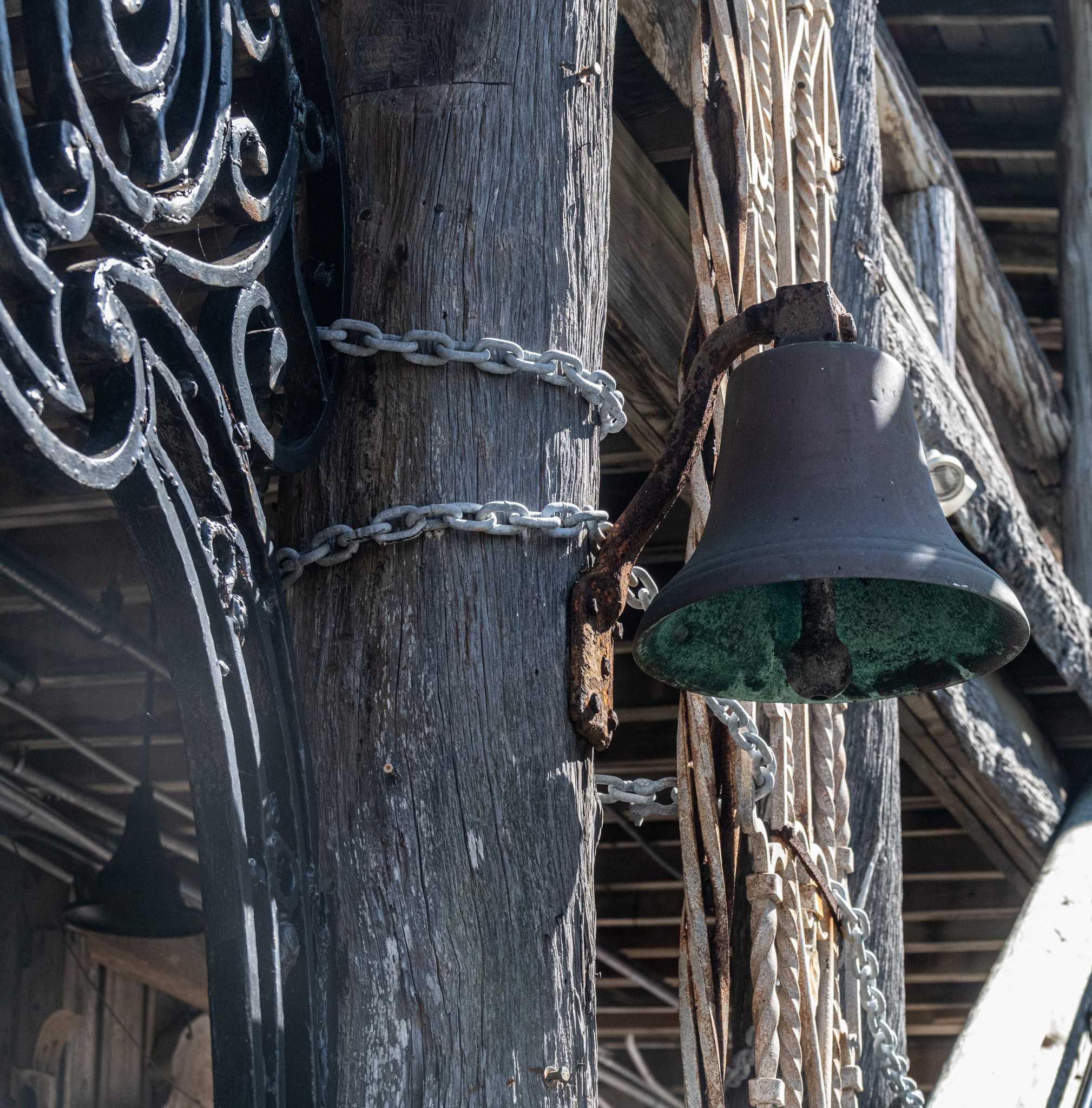
of bells and amassed a collection of 250 of various types and sizes, collecting them from
churches, trains, ships and schools. They decorate the exterior of the buildings and have
always been a special part of the Driftwood Inn tradition. They were used to welcome guests
on their arrival and to ring out a farewell on their departure.


Waldo continued to expand the Driftwood complex after erecting the inn and restaurant. A
small office was built in 1949. In that year he also moved in a row of fishing shacks that
were used for guest rooms and later, for small shops. They were converted back to guest
rooms in 1986. In 1963 a 15-unit apartment building was added, just west of the original
Breezeway building. Waldo’s son, Ralph, erected the four-story building to the south in
1965, providing more apartment units. Two more apartment buildings are now part of the
Driftwood Resort, which was converted to interval ownership in 1979.


The Driftwood Resort and Waldo’s Restaurant feature a rustic “beachcomber” ambience.
While structures of similar style are found elsewhere in Florida, few are comparable in scale
or complexity of detail. The two buildings are unique in the Vero Beach area and continue to
serve their historic function of providing accommodations and amenities for tourists. Both
were conceived and operated by . . . Waldo Sexton.
Full disclosure: not having rented a room here, I did not have access to all that was available.
Therefor, what you are seeing is what caught my eye as I walked around.








 Posts
Posts

