Tuesday, November 9, 2021

Milkweed


I came across an exuberant amount of milkweed plants. Each plant having its unique texture and pose. Some had opened up and allowed their seeds to flow, while others were waiting to crack open. A few had the milkweed bugs resting on them.

"Milkweed grows to about 1.5 meters(5 feet) tall, usually occurring in clusters of stout stems. It has rhizomes and quickly forms colonies. Leaves are 15-20 centimeters (6-8 inches) long and 5-9 centimeters (2-3.6 inches) wide. They are somewhat thick with a prominent midrib beneath. The upper surface is light to dark green while the lower surface is lighter, almost white at times. Broken leaves and stems exude a milky latex. Flowers are borne in nearly spherical clusters (umbels) at the top of the plant, usually with 2-5 clusters per plant. Each flower is about 2 centimeters (0.75 inches) long and 1 centimeters (0.4 inches) wide. Flowers are greenish-pink to rosy pink to purplish-pink and very strongly and sweetly scented. Fruits (pods) are about 10 centimeters (4 inches) long, inflated and covered in little finger-like projections. They are green initially, turning brown as they mature. They split open revealing 50-100 seeds each with a white, fluffy coma ("parachute") that allows wind dispersal."


"Common milkweed is Nature's mega food market for insects. Over 450 insects are known to feed on some portion of the plant. Numerous insects are attracted to the nectar-laden flowers and it is not at all uncommon to see flies, beetles, ants, bees, wasps, and butterflies on the flowers at the same time. Occasionally hummingbirds will try, unsuccessfully, to extract nectar. Its sap, leaves and flowers also provide food. In the northeast and Midwest, it is among the most important food plants for monarch caterpillars."


"Other common feeders are the colorful (red with black dots) red milkweed beetle (Tetraopes tetraophthalmus), the milkweed tussock caterpillar (Euchaetes egle) and the large (Oncopeltus fasciatus) and the small (Lygaeus kalmia) red and black milkweed bugs. The latter two are particularly destructive as both the adults and nymphs are seed predators. They can destroy 80 to 90 percent of a colony's seed crop. The red (or orange-red) and black coloration of most of these insects is known as aposematic coloration; that is, the colors advertise the fact that the organism is not good to eat."


"Milkweeds contain various levels of cardiac glycoside compounds which render the plants toxic to most insects and animals. For some insects, the cardiac glycosides become a defense. They can store them in their tissue which renders them inedible or toxic to other animals. Monarch butterflies use this defense and birds leave them and the caterpillars alone. What the birds do not know is that northern monarchs feeding on common milkweed accumulate relatively little of the toxic compounds and probably would be edible. The more southern butterflies accumulate large amounts of the compounds from other milkweed species and are in fact toxic. Monarchs can be helped by encouraging existing patches and planting new ones. The plant grows readily from seed and spreads quickly by deep rhizomes." 


As mentioned above the plant is toxic as well as being very invasive, but at the same time it is a very attractive plant, especially when the pods open up and the floss and seeds dance with the wind.


(source)

Monday, November 8, 2021

Hands At Play

 The hands were looking for something to do. I complied and had them play with some droplets and dried flowers, while I tried to take a photo or two.

I used selective colors on the first photo, accentuating the orange from the orange flower.

Exif: 1/160 sec. f/6.3 150mm, ISO 1250


While on the second photo I increased the light and used the macro lens.
Exif: 1/80 sec. f/5 60mm, ISO 800


What you see in the droplet is the refracted hand with the flower.

Sunday, November 7, 2021

Reservations?

 When you fly into your favorite spot and forget to make reservations in advance.


No Ticky! No Laundry!

Friday, November 5, 2021

Week 45- Extra Credit

 This week's challenge had to do with capturing one's fear. I have a fear of heights and I was not about to capture that fear. Because in order to capture I would probably have to climb something pretty high up, to take a photo looking down. Sure I could do some photoshopping type of adjustments but then it would not be photography (at least for me). Instead I chose to complete the extra credit challenge.

The extra credit was "new photography technique".

The technique I chose was light painting. No it's not a new technique for me, because playing with a flashlight in a dark, dark room and taking various photos has been in my repertoire for a long time. What changed in this process was the use of an ND filter.

We all know that neutral density filters have been used outdoors to cut down the amount of light that comes into the camera. Most photographers use the filter when capturing landscapes or waterscapes. For example when wanting to create smooth silky water, the neutral density filter is placed on the lens, cutting down the amount of light entering the camera, which then allows the photographer to decrease the shutter speed and have a long exposure shot. 

In the case of light painting, I used the neutral density filter to cut down the ambient light.  Therefor giving me the ability to play, not in a dark, dark room, but rather in a very well lit room and yet be able to slow down the shutter speed to an amount that would be slow enough to light paint.

 The above photo was my first attempt. I was so focused on the light and where to aim/paint that I did not adjust the focus. Hence, the focus is on the loose Brussel sprouts while the ones in the colander are out of focus.  I would have liked everything to be focused. The exif for the above photo is: 30 sec. f/4 50mm, ISO 64.

On the next photo, I thought..... how about I pour some water from a yellow watering can with one hand and light paint with the other. I am not ambidextrous but I managed. Or I thought I did. That yellow glow on the top of the jar is the light shinning on the watering can but what you can't see is the water pouring down. 

Exif: 30 sec. f/4 50mm, ISO 64


The next photo was the same set up as the one above but this time I added  a candle to the scene.
Exif: 30 sec. f/4 50mm, ISO 64


This last photo was slightly different than the other three. I decided to take four separate shots. In each shot I aimed and painted with the flashlight on one specific area. For example on one shot the flashlight lit up just the flower basket, on another just the newspaper, and so forth. Then I took all four of the captures and stacked them in photoshop, resulting in the photo below.
Exif: 20 sec. f/6.3 50mm, ISO 160.

Because of the contrast between the light and dark in the above photo, this particular capture can also fall into the Chiaruscuro technique of photography. 

And so the saying "Two birds with one stone" can be applied here as well 😉


Tuesday, November 2, 2021

Sunrise

 Today would have been the 9th day without any signs of the sun. The key word is would have been, had it not tried to show it's face first thing this morning.

 And show it did.....


Well, let me rephrase that. It turned the sky aglow for about half an hour and then sadly, the clouds told it to go back home since they were in control, AGAIN!


Cooper or Sharp Shined Hawk?

 Sometimes a photo opportunity just falls into one's lap and so one has to take advantage of the situation.

This particular hawk and its mate seem to have a nest high up the trees close to our house.


Several times this summer, my husband who gets up way before me to go to work, saw the hawk scoping our yard. Sometimes he would just sit on the fence other times he would just fly over. Each time after the sighting my husband would say, wish you were up you could have taken its photo. As mu as I like photography, I like my beauty sleep more, so getting up early in hopes of catching this guy for a photo shoot was not in the realm of reality.

As the saying goes " Good things come to those who wait. A good thing did come along for me. One morning after I had gone to my normal routine, looked out the window and saw his majestic self sitting on the fence.


I knew if tried to open the sliding door to step outside and capture his photograph, he would be gone in a blink.  Therefor, from inside the house through the glass door with my 500mm lens attached to the Nikon D750 I started clicking away.  Capturing a few of him his movements.


This whole process of looking this way and that way, took about three minutes. And then he was gone. To be honest I wondered if he was waiting for my little chipmunk friend who resides under our patio and not seeing him anywhere around he chose to leave. 


Maybe one of these days I will get lucky and he will return and sit for a while, giving me the opportunity to photograph him again. This time, I hope to have better photos. It was suggested that if I raise my f/stop to about 1600 I would have a better chance of capturing a much sharper photo than the ones I have taken so far. 

We shall see if I get lucky.😊

Incidentally I have no idea which type of hawk this is. I had never heard of a sharp shined hawk until a friend brought it. Apparently there is a size difference between the two, one being smaller than the other. 


Monday, November 1, 2021

Flying South

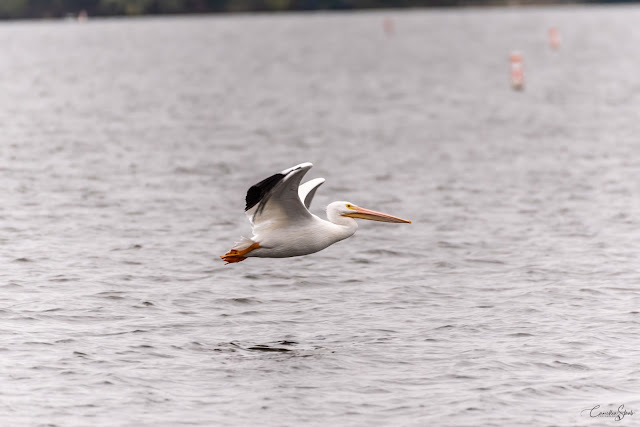
 Every once in a while a group of pelicans land in our lake. They spend some time swimming around, eating the fish, and chillaxing about, and then slowly slowly head out before the cold weather sets in.

These three pelicans were hanging around with the ducks when I arrived at the park, giving me the perfect opportunity to take some photos.


One of them took off while the other two just watched and waited.


And then it seemed like the time had come for both of them to take flight as well. 


Followers